

An employee joins a startup and receives equity while the company’s shares are worth very little. Several years later, the company is sold and the shares produce a substantial gain. Is that increase taxed as compensation or capital gain and can New York tax it after the employee moves away?
A Section 83(b) election can materially affect the answer. The election allows an eligible recipient of restricted property to recognize compensation when the property is transferred rather than when it vests. When the shares have a low value at transfer, the election allows a relatively small compensation amount to be established and permits later appreciation to be treated as capital gain.
For the election to be valid, it must be made in relation to property that was actually transferred, it must be timely and complete, and the value reported must be supportable. A purported election filed when an employee received only an unexercised option generally does not protect the later appreciation.
For New York taxpayers, the result depends on the type of award, the timing of exercise and vesting, New York workdays, the taxpayer’s residency when income is recognized, and whether a sale had effectively become fixed before a move.
This article discusses the federal Section 83(b) election, what it is, which equity awards benefit from it and how a valid election is made before explaining the New York rules for residents, nonresidents and part-year residents.
For a broader explanation of incentive stock options (ISOs), nonstatutory stock options (NSOs), restricted stock awards (RSAs), restricted stock units (RSUs) and employee stock purchase plans (ESPPs), see our Equity-Based Compensation Tax Guide.
Note: Equity compensation and residency determinations are highly fact-specific. This article provides general information and is not a legal opinion or a substitute for reviewing the governing equity documents, valuations, workday records and residency evidence.
Key takeaways
- A Section 83(b) election generally applies only after substantially nonvested stock or other property has actually been transferred.
- An election filed when the taxpayer holds only an unexercised option is usually ineffective because the underlying shares have not been transferred.
- The election must be filed with the IRS no later than 30 days after the property-transfer date; there is no general extension for a missed deadline.
- A zero-income election can be valid when the shares’ fair market value equals the amount paid.
- A valid election generally measures compensation at transfer, allowing later appreciation to fall outside Section 83 and potentially qualify as capital gain.
- Moving out of New York does not automatically eliminate New York tax. The result depends on the award, the compensation component, the allocation period, New York workdays, residency and transaction timing.
- For a New York nonresident, the workday fraction generally applies to the compensation component not automatically to the entire gain from selling the shares.
Interactive NY Equity Tax Decision Tree
Step 1: Was a binding merger, acquisition, or sale contract executed before you physically moved out of NY?
Table of Contents
What Is a Section 83(b) Election?
Internal Revenue Code Section 83 applies when property is transferred in connection with services. This commonly includes stock issued to a founder, employee, director or independent contractor subject to a vesting schedule.
Shares are substantially nonvested when they remain subject to a substantial risk of forfeiture and are not transferable free of that risk. For example, an employee may receive 100,000 shares but be required to return the unvested shares if employment ends before a four-year vesting period is completed.
The default rule without an election
Without a Section 83(b) election, compensation is recognized when the shares become substantially vested. The amount ordinarily equals:
Compensation = FMV when the shares vest − amount paid
If the shares increase substantially in value before vesting, the employee may recognize significant ordinary compensation income as each tranche vests even though the employee has not sold the shares and may not have cash available to pay the tax.
What the election changes
A Section 83(b) election moves the compensation measurement date from vesting to the earlier transfer date. The employee elects to recognize:
Compensation = FMV when the shares are transferred − amount paid
Once the compensation element is properly measured at transfer, later appreciation generally is no longer taxed under Section 83 as additional compensation. If the applicable holding period and other requirements are met, the later increase may qualify as capital gain when the shares are sold.
The amount paid for the shares, together with any compensation recognized under the election, establishes the employee’s tax basis. The capital gain holding period also begins at transfer rather than being postponed until vesting.
A simple example
Assume an employee pays $1,000 for restricted shares worth $1,000 when transferred. The shares vest over four years and are worth $250,000 when fully vested.
With a valid Section 83(b) election:
$1,000 FMV − $1,000 paid = $0 compensation at transfer
Without the election, as much as $249,000 could be recognized as compensation as the shares vest, depending on their value at each vesting date. With the election, subsequent appreciation generally remains outside Section 83 and may become capital gain upon sale.
The election therefore does not eliminate tax. It changes the timing and potentially the character of future appreciation.
Which equity awards can benefit from Section 83(b)?
The election generally applies only after substantially nonvested property has been transferred. It does not apply merely because an employee has received a contractual promise or the right to acquire stock later.
Table 1: Equity Arrangements and Section 83(b) Applicability
| Equity arrangement | Is a Section 83(b) election generally available? | Why? |
|---|---|---|
| Restricted stock award involving actual nonvested shares | Potentially yes | Shares have been transferred but remain subject to forfeiture |
| Early-exercised NSO resulting in actual nonvested shares | Potentially yes | The election applies to the shares received upon exercise not to the original option grant |
| Unexercised stock option | Generally no | The underlying shares have not been transferred |
| Restricted stock unit | No at grant | An RSU generally represents a promise to deliver shares or cash in the future |
| ISO exercised for nonvested shares | Limited | The election may affect AMT treatment, but generally not regular tax treatment while Section 421 applies |
| Fully vested shares | Generally unnecessary | Section 83 income is already recognized at transfer because the shares are vested |
Restricted stock awards and restricted stock units are frequently confused. An RSA generally involves present ownership of actual shares subject to restrictions. An RSU ordinarily promises a future payment in stock or cash and does not transfer property at grant.
How to make a valid Section 83(b) election
A defensible election requires all of the following.
1. Eligible property must actually be transferred
The recipient must obtain a beneficial ownership interest in substantially nonvested property. For stock, the evidence may include the award or purchase agreement, board approval, proof of payment, stock ledger, capitalization table and certificate or electronic issuance record.
If the taxpayer received an option, the documents should establish that the option was actually exercised and that shares were issued. Filing an election before exercise generally does not substitute for a share transfer.
2. The property must remain substantially nonvested
The shares ordinarily must be subject to a genuine substantial risk of forfeiture, such as a requirement to continue providing substantial services. Restrictions that merely limit marketability do not necessarily establish a substantial risk of forfeiture.
3. The election must be filed within 30 days
The election must be filed no later than 30 days after the property transfer date. The period is not measured from the option-grant date unless that date is also the date qualifying property was transferred. There is no general extension for an inadvertently missed deadline.
If the 30th day falls on a Saturday, Sunday or legal holiday, the filing deadline generally moves to the next business day. Because the consequences of a missed deadline can be substantial, taxpayers should identify the transfer date from the governing documents rather than assume it is the option-grant, vesting or payment date.
4. The election must contain the required information
The election must identify the taxpayer, describe the property and restrictions, state the transfer date and tax year, disclose the property’s FMV and the amount paid, and include the required election statement. The IRS provides Form 15620, Section 83(b) Election, although taxpayers may use a compliant written statement instead. The election may be filed with the IRS service center where the taxpayer files the federal income tax return or submitted online through the IRS website, and a copy must also be provided to the person for whom the services were performed.
For property transferred after 2015, the taxpayer is no longer required to attach a copy of the election to the federal income tax return. That change does not remove the separate 30-day filing requirement or the requirement to provide a copy to the service recipient.
Taxpayers should retain the signed election and reliable proof of timely filing. A return preparer reviewing the eventual stock sale may otherwise have no way to verify that the election became effective.
5. The transfer-date value must be supportable
FMV is determined without regard to restrictions that will lapse. A startup’s common shares may be highly speculative and illiquid, but those characteristics do not automatically make them worthless. Contemporaneous capitalization records, financing terms and valuation reports can become critical when a later liquidity event produces a large gain.
Tradeoffs of a Section 83(b) Election
Section 83(b) is most attractive when the current compensation spread is small and substantial appreciation is expected. It also carries risk:
- The election accelerates tax to the transfer year even though the shares may not yet be liquid.
- If the shares are later forfeited, the taxpayer generally cannot recover tax paid on the compensation previously elected into income.
- The election generally cannot be revoked without IRS consent.
- An incorrect transfer date, late filing or election made for an ineligible award may leave the compensation element open until vesting or exercise.
The decision should therefore be made when the equity is issued, based on the award terms, valuation, expected appreciation and forfeiture risk, not reconstructed for the first time when the company is sold.
Section 83 Property Transfers: Was Stock Actually Transferred?
The IRS’s Equity (Stock)-Based Compensation Audit Techniques Guide, Publication 5992, directs examiners to verify Section 83(b) elections and the underlying property transfers.
The guide specifically warns that an election made upon receipt of a stock option is usually ineffective because Section 83(b) requires transferred property. Most privately issued employee options do not have a readily ascertainable FMV at grant and are not treated as eligible property for this purpose. If substantially nonvested shares are later issued through exercise, an election may then be available for those shares.
Corporate labels are not conclusive. An agreement may be called an “award” even though no shares were transferred, or it may involve an option that was never exercised. Substance and contemporaneous records control.
Table 2: Practical Example in an Audit
| Company Label | Records Indicate | Issue requiring analysis |
| Incentive Stock Option (ISO) | Exercise price may have been below grant-date FMV | Option may fail statutory ISO requirements (IRC § 422) and implicate IRC § 409A. Tax consequences depend on governing plan terms, contemporaneous 409A valuation, vesting schedules and correction history. |
| Restricted Stock Award (RSA) | No shares appear on the stock ledger or capitalization table | Determine whether a legal transfer of property occurred (Treas. Reg. § 1.83-3(a)). If no shares were actually transferred, a purported Section 83(b) election is invalid. |
| Early Exercise Option | Exercise notice exists, but payment and share-issuance records are incomplete | Verify consideration paid, board authorization, stock-ledger entries, and actual share issuance before concluding a qualifying property transfer occurred for Section 83 purposes. |
Internationally mobile employees granted NSOs abroad face an added layer of complexity when filing a Section 83(b) election. See our cross-border NSO taxation guide for how early-exercise NSOs interact with foreign tax credit timing mismatches and nonresident alien status.
Zero FMV vs. Zero Taxable Compensation
These concepts may produce the same number on an election, but they carry fundamentally different legal consequences and evidentiary requirements upon audit.
Shares with an asserted zero FMV
If restricted shares were transferred for no payment and their fair market value was genuinely zero, the election would report zero compensation:
$0 FMV − $0 paid = $0 compensation
The difficulty is substantiating that the shares themselves were literally worthless. Startup shares may be illiquid, speculative and worth very little without necessarily having a zero fair market value. Section 83 valuation also generally disregards restrictions that will lapse.
Positive FMV equal to the amount paid
The shares may have positive value while producing no taxable spread:
$10,000 FMV − $10,000 paid = $0 compensation
This is a conventional zero-compensation election. In Revenue Procedure 2012-29 provides sample election language and illustrates that a valid Section 83(b) election can produce zero compensation when the property’s FMV equals the amount paid. The sample language may be used but is not required, and it does not substitute for a qualifying property transfer, timely filing or supportable valuation.
An option without a readily ascertainable FMV
This phrase does not mean the option is economically worthless. It means the option does not satisfy the demanding regulatory requirements for determining its value at grant. In particular, option value is not necessarily limited to its immediate intrinsic spread; the opportunity to benefit from future appreciation can itself have value.
Accordingly, filing an election on an unexercised option and reporting zero does not lock in future capital gain treatment. If no qualifying property was transferred, the election is generally ineffective.
How New York allocates equity compensation
New York Tax Law Section 631(g), 20 NYCRR Section 132.24, and TSB-M-07(7)I establish special rules for stock options, restricted stock and stock appreciation rights received in connection with services performed in New York.
For a nonresident, the general formula is:
New York-source compensation = equity compensation × (New York workdays during the allocation period ÷ total workdays during the allocation period)
The critical point is that the formula ordinarily applies to the amount classified as compensation, not automatically to every dollar of federal capital gain.
CRITICAL AUDIT NOTE — The “Convenience of the Employer” Rule:
When counting physical workdays in the numerator of your workday allocation fraction (NY Workdays/Total Workdays), remember that New York applies its strict “Convenience of the Employer” rule (20 NYCRR § 132.18). If you worked remotely from an out-of-state home office for a New York–based employer during the grant-to-vest/exercise allocation period, those remote days will still be treated as New York workdays unless your home office meets New York’s rigorous multi-factor test to qualify as a bona fide employer location.
New York Residents: Taxation of Equity Compensation and Gains
A New York resident is generally taxed on income from all sources. If equity compensation is recognized while the taxpayer is a New York resident, the entire compensation amount generally enters New York income.
For statutory stock options, including incentive stock options, New York’s part-year-resident guidance is particularly important. If the stock is sold and the income is recognized during the resident period, the entire federally recognized gain including the compensation element and post-exercise appreciation is included in New York income.
Therefore, a taxpayer who exercises an ISO at a low value but sells the shares before leaving New York generally cannot exclude the post-exercise appreciation merely because it constitutes investment gain for a nonresident.
For a broader discussion of New York residency, domicile, multi-state income and remote-work rules, visit our New York CPA tax and advisory services page.
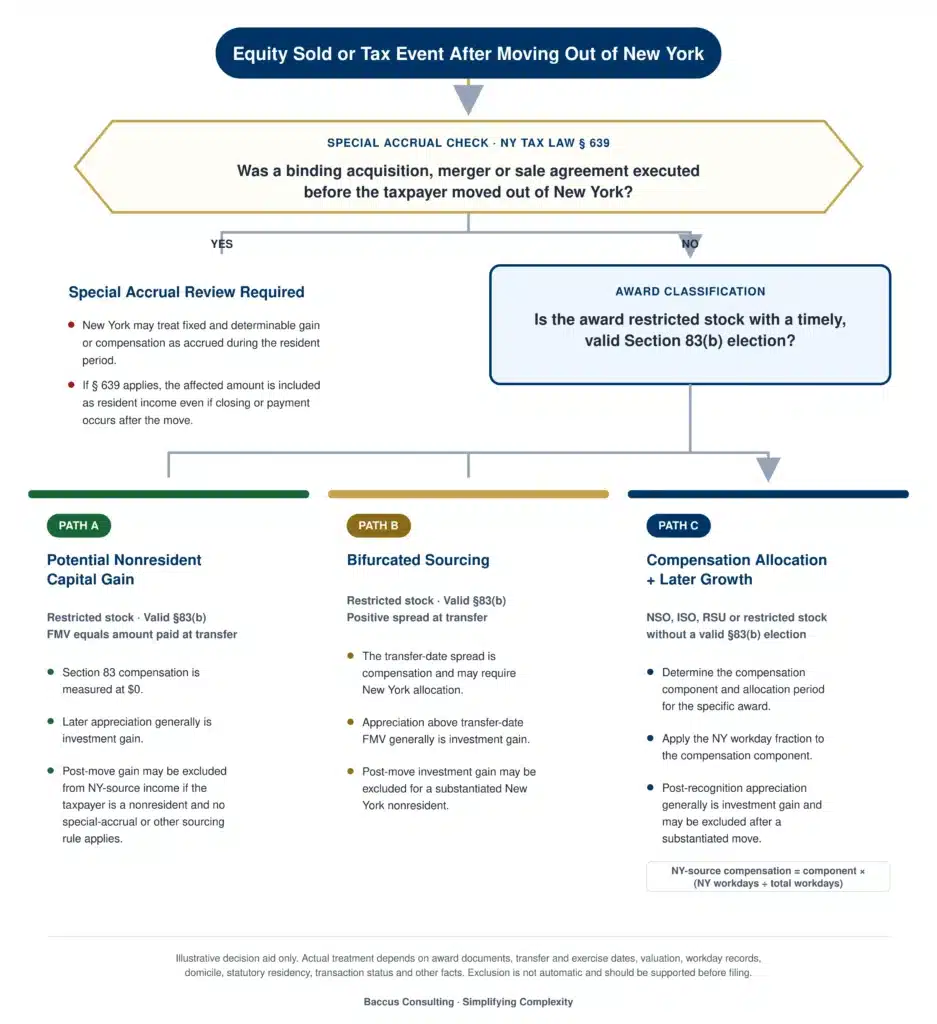
Figure 1: New York Equity Compensation Sourcing & Special Accrual Decision Tree.
Use this chart to determine how your equity gains are classified and allocated after a change of domicile. Note that NY Tax Law § 639 serves as an overriding gate: if a sale or acquisition agreement was legally fixed prior to your move, New York taxes the resulting gain as resident income regardless of award type or 83(b) status. Detailed statutory breakdowns for nonresident allocation under Paths A, B, and C follow below.
New York Nonresidents: Sourcing Equity Compensation and Investment Gains
A nonresident is taxed only on income derived from or connected with New York sources. Equity compensation can remain New York-source after the taxpayer leaves because the allocation period may include earlier periods when the taxpayer lived or worked in New York.
The treatment depends on the award.
Statutory stock options, including ISOs
For a statutory option, federal income is generally recognized when the shares are sold. Even if the federal gain receives capital gain treatment, New York treats part of that gain as compensation for services.
The compensation component generally is limited to the lesser of:
- the exercise date spread which equals FMV at exercise minus the option price; or
- the actual federal gain recognized on the sale.
New York then multiplies that compensation component by the New York workday fraction for the grant-to-vest period.
Any additional appreciation after exercise generally represents investment income not taxable to a New York nonresident. This distinction comes from Matter of Michaelsen v. New York State Tax Commission, 67 N.Y.2d 579 (1986), and is incorporated into Section 132.24.
Example: ISO sold after moving from New York
Assume:
- Option price: $10,000
- FMV at exercise: $60,000
- Sale proceeds: $250,000
- Federal gain: $240,000
- New York workday fraction for the grant-to-vest period: 80%
The compensation component is limited to the $50,000 exercise-date spread:
$60,000 − $10,000 = $50,000
The New York-source amount is:
$50,000 × 80% = $40,000
The remaining $190,000 of post-exercise appreciation is generally nonresident investment gain rather than New York-source compensation.
If the option price and FMV at exercise were both genuinely zero, the exercise-date compensation spread would also be zero. Subject to verification of the exercise, share transfer, valuation and residency, later appreciation could be excluded from New York-source income.
Nonstatutory stock options
Most NSOs do not have a readily ascertainable FMV at grant. Compensation is generally recognized at exercise and equals:
Compensation = FMV at exercise − exercise price
New York generally allocates the compensation over the grant-to-vest period. Appreciation or depreciation after exercise is investment gain or loss and is generally not included in a nonresident’s New York-source income.
If an employee merely received an option, filed a purported Section 83(b) election without exercising it, and later exercised when the spread was $250,000, the ineffective election would not prevent the $250,000 from being treated as compensation. New York would then apply the grant-to-vest workday fraction.
Restricted stock with a valid Section 83(b) election
When actual restricted shares are transferred and a valid election is made, compensation generally equals:
Compensation = FMV when shares were received − amount paid
The allocation period generally corresponds to the period used for the employee’s regular non-stock compensation during the year the shares were received. Once the compensation event has been properly closed, subsequent appreciation ordinarily represents investment gain.
The result depends on proving the share transfer and a defensible transfer-date value. An election filed only for an unexercised option does not receive this treatment.
Restricted stock without a valid Section 83(b) election
Without a valid election, compensation is recognized when the stock becomes substantially vested:
Compensation = FMV at vesting − amount paid
If the nonvested stock is sold in an arm’s-length transaction before vesting, compensation generally equals the sale proceeds less the amount paid.
For New York purposes, the allocation period runs from receipt of the stock to the earliest of:
- substantial vesting;
- termination of services; or
- sale of the stock.
The compensation is multiplied by the New York workday fraction for that period. Appreciation after the compensation-recognition event generally is nonresident investment gain.
New York Part-Year Residents: Allocating Equity Income Between Residency Periods
Part-year treatment depends on the taxpayer’s status when the equity income is recognized.
Recognition during the resident period
If compensation is recognized while the taxpayer is a resident, the entire compensation amount is included in New York income. For statutory options, New York includes the entire federal gain or loss recognized during the resident period, including post-exercise appreciation.
Recognition during the nonresident period
If compensation is recognized after the taxpayer becomes a nonresident, New York applies the nonresident allocation rules described above.
This does not necessarily mean multiplying the entire federal gain by the workday fraction. The taxpayer must first calculate the compensation component under the rules applicable to the particular equity instrument. The fraction is then applied to that compensation component.
New York City treatment
New York City does not impose its personal income tax on nonresidents. Under TSB-M-07(7)I, equity compensation recognized during the New York City resident period is included in City income, while compensation recognized during the nonresident period is not subject to New York City personal income tax.
New York State may nevertheless tax the allocated New York-source compensation after the taxpayer leaves the City or State.
Taxpayers who relocate from New York to New Jersey may also need to coordinate the New York nonresident return, the New Jersey resident or part-year return and any available resident credit. Our New Jersey CPA tax and advisory services page discusses these multi-state considerations.
Moving Before an Equity Sale: Domicile and Transaction Timing
A taxpayer may legally change domicile before a liquidity event, even when state tax savings influence the decision. But a move shortly before a significant stock sale is likely to receive greater scrutiny.
The taxpayer must establish a genuine abandonment of New York domicile and the establishment of a new domicile elsewhere. New York may examine the taxpayer’s homes, family location, business involvement, time spent in each jurisdiction, personal possessions and other evidence of where the taxpayer intended to maintain a permanent home.
The taxpayer must also avoid New York statutory residency, which can arise when an individual maintains a permanent place of abode in New York and spends more than 183 days in the state during the year.
The Special Accrual Rule (§ 639)
Moving before formal transaction closing does not necessarily establish that the gain arose during the nonresident period. New York’s special-accrual rules can apply when an item of income or gain was fixed and determinable when the taxpayer changed residence.
Important: The “Fixed & Determinable” Trap under NY Tax Law § 639 Moving out of New York before a merger, acquisition, or stock sale closes does not protect your gain if the sale was already legally fixed before your move.
Under NY Tax Law § 639, if a binding purchase agreement or definitive merger contract is executed while you are still a NY resident, New York treats the entire resulting gain as having accrued during your resident period even if shareholder approval, regulatory clearance, or actual cash payout happens months later after you have moved.
Taxpayers who execute a binding agreement before physically moving frequently trigger this trap, making the entire gain taxable as a resident event regardless of when closing occurs. To exclude post-move gains, the move must occur before the transaction becomes legally binding and unalterable.
When evaluating whether an item of income or gain accrued prior to a move, relevant facts include:
- whether a binding sale, merger or tender agreement had already been executed;
- whether material board, shareholder, regulatory or financing approvals remained outstanding;
- whether the taxpayer was irrevocably committed to sell;
- whether the price or exchange ratio was fixed; and
- whether meaningful contingencies remained.
Knowledge that a transaction may occur is not necessarily the same as having a fixed right to the proceeds. Nevertheless, a taxpayer who moves after a transaction has effectively become binding may face a New York accrual challenge even if payment and formal closing occur later. If a taxpayer triggers a § 639 special accrual upon moving, NY Tax Law § 639(d) allows them to post a bond or acceptable security with the Tax Commissioner to defer paying the NY tax until the gain is actually realized/closed. The same special-accrual framework governs prior-year cash bonuses paid after a change of residency, which follow a separate fixed-and-determinable test from the equity rules above. See our guide on taxation of a bonus paid after a move to or from New York.
Continuing employment with a New York employer
The employer’s New York location does not, by itself, convert all subsequent stock appreciation into New York-source compensation. The relevant question is what portion of the proceeds remains compensation for services and how the applicable workdays are allocated.
Continued employment can still matter because:
- vesting may continue after the move;
- the grant-to-vest allocation period may include both New York and non-New York workdays;
- future wages may remain New York-source; and
- New York’s convenience-of-the-employer rule may treat certain home-office days as New York workdays unless the out-of-state work is performed from necessity rather than convenience.
The convenience rule does not automatically convert post-exercise investment appreciation into compensation, but it can affect the workday fraction applied to the compensation component.
An ISO exercise may also create an alternative minimum tax adjustment even when no regular federal income tax is due at exercise. See our Alternative Minimum Tax Guide for a broader explanation of ISO exercises, AMT exposure and AMT credit considerations.
Documents Needed to Support the New York Tax Treatment
A taxpayer claiming that significant post-exercise appreciation is not taxable by New York should maintain contemporaneous documentation, including:
- the equity incentive plan;
- option, RSA, RSU or restricted stock agreement;
- board and compensation committee approvals;
- exercise notice and proof of payment;
- stock certificate, electronic ledger and capitalization table;
- vesting, forfeiture and repurchase provisions;
- Form 3921 for an ISO, where applicable;
- employer payroll and W-2 reporting;
- contemporaneous valuation reports and capitalization data;
- the signed Section 83(b) election;
- proof of timely filing and delivery to the employer;
- grant-to-vest workday records;
- sale, tender or merger documents and approval chronology;
- New York day-count records; and
- evidence supporting the change of domicile.
The evidence should establish not only that an election was mailed, but also that eligible property was actually transferred and accurately valued.
Download the Documentation Checklist
Use this checklist to organize the equity, valuation, workday, residency and transaction records that may be needed to support your tax position.
This checklist provides general information. Required documentation depends on the equity arrangement, transaction history and residency facts.
Common mistakes
Filing an election when only an option was granted
An unexercised option ordinarily does not constitute the transfer of the underlying shares. Filing an election does not cure the absence of a property transfer.
Treating “no readily ascertainable FMV” as “worthless”
These are different concepts. A privately issued option may fail the regulatory valuation test while still possessing economic value.
Assuming every zero-income election is invalid
A valid election can produce zero compensation when the recipient pays an amount equal to the transferred shares’ FMV.
Assuming federal capital gain treatment controls New York sourcing
For statutory options, New York can treat the exercise-date spread as compensation even when the entire federal gain is reported as capital gain.
Allocating the entire sale gain without separating post-exercise appreciation
For a nonresident sale, the New York workday fraction generally applies to the compensation component. Post-exercise appreciation may be excluded as investment income.
Assuming a move immediately eliminates New York exposure
The taxpayer must substantiate domicile, statutory-residency status, transaction timing and the special-accrual analysis. A strategically timed move may be valid, but the evidentiary burden can be substantial.
Frequently asked questions about Section 83(b) elections
Who should consider a Section 83(b) election?
The election is commonly considered by founders, employees and other service providers who receive substantially nonvested stock with a relatively low current value and meaningful potential for appreciation. The expected benefit must be weighed against the risk of paying tax before liquidity and receiving no refund if the shares are later forfeited.
Can an 83(b) election be made for an unexercised stock option?
Usually not. Section 83(b) generally requires an actual transfer of substantially nonvested property. An unexercised option ordinarily represents a right to acquire shares later, not a present transfer of the underlying shares. If the option is later exercised for nonvested shares, an election may then be available for those shares.
Can an 83(b) election be made for restricted stock units?
Not at grant. An RSU ordinarily represents an unsecured promise to deliver stock or cash in the future and therefore does not transfer property at grant. Receiving actual restricted shares under an RSA is different from receiving an RSU.
Does an 83(b) election apply to an ISO or NSO?
It generally does not apply merely because an ISO or NSO was granted. It may become relevant when an option is exercised early and actual nonvested shares are issued. For an ISO, the election can affect the alternative minimum tax analysis but generally does not override the regular tax statutory option rules while Section 421 applies.
What is the deadline for filing an 83(b) election?
The election must be filed with the IRS no later than 30 days after the substantially nonvested property is transferred. There is no general extension for a missed deadline. If day 30 falls on a Saturday, Sunday or legal holiday, timely filing generally extends to the next business day.
Can a late 83(b) election be corrected?
There is no general procedure that permits a taxpayer to cure an inadvertently missed 30-day deadline. A taxpayer facing a possible late or defective election should obtain advice based on the precise transfer documents, dates and filing evidence rather than assume the election can be corrected with the annual return.
Can an 83(b) election be revoked?
Generally, an election cannot be revoked without IRS consent. The governing rules provide only limited relief, principally involving a qualifying mistake of fact about the underlying transaction. A decline in the stock’s value or a change in the taxpayer’s expectations generally is not enough by itself.
Must the election be attached to the income tax return?
For property transferred after 2015, a copy generally is not required to be attached to the federal income tax return. The taxpayer must still satisfy the separate 30-day filing requirement and provide a copy to the person for whom the services were performed.
Does a zero-income 83(b) election mean that the shares had zero value?
Not necessarily. The shares may have a positive FMV equal to the amount paid, producing no compensation spread. Claiming that shares were literally worth zero is a different and potentially more difficult valuation position that should be supported by contemporaneous evidence.
What happens if the shares are forfeited?
The taxpayer generally cannot recover the tax paid on compensation included through the election merely because the shares are later forfeited. Any resulting loss may be limited based on the amount paid for the shares and the applicable tax rules, which is why forfeiture risk should be evaluated before making the election.
Does moving out of New York make the stock-sale gain nontaxable to New York?
Not automatically. A nonresident’s post-exercise or post-election investment appreciation may fall outside New York-source income, but New York may still tax the allocable compensation component. Residency, domicile, statutory residency, transaction timing and special accrual must also be analyzed and documented.
Does New York apply the workday fraction to the entire stock-sale gain?
Generally, not automatically. The taxpayer must first determine the portion treated as compensation under the rules for the particular award. The New York workday fraction is then applied to that compensation component. Additional investment appreciation may be excluded for a nonresident if the facts and documentation support that treatment.
Practical conclusion
A Section 83(b) election can materially change the taxation of startup and other equity compensation, but the election is not effective merely because it was filed. The taxpayer must first establish that substantially nonvested property was actually transferred.
For New York purposes, the correct sequence is:
- Identify the equity instrument.
- Confirm whether and when actual shares were transferred.
- Determine whether a Section 83(b) election was available and timely.
- Establish FMV and the amount paid at the relevant date.
- Separate compensation from subsequent investment appreciation.
- Identify the applicable grant-to-vest or restricted-stock allocation period.
- Calculate the New York workday fraction.
- Determine residency when the income was recognized.
- Review domicile, statutory residency and special accrual when a move precedes a liquidity event.
A favorable nonresident rule is not a substitute for evidence. For a material transaction, the taxpayer should complete the analysis before filing and retain documentation capable of supporting the position in a New York examination.
Get professional guidance for a significant equity transaction
Equity-compensation and residency positions often depend on documents that should be reviewed before the return is filed and where possible, before an option exercise, relocation or liquidity event is completed.
Baccus Consulting assists professionals, executives and founders with federal and multi-state equity-compensation tax analysis, including Section 83(b) elections, ISO and NSO exercises, restricted stock, AMT, New York residency and income allocation.
Get in touch to discuss your tax needs. Discovery consultations are used to understand the matter and determine the appropriate engagement scope. Document review, calculations and technical conclusions are provided under a formal engagement.
Related Baccus Consulting resources
- Equity-Based Compensation: Key Tax and Wealth Planning Considerations
- Alternative Minimum Tax: What Triggers It and How It Is Calculated
- New York Taxation of Prior-Year Bonus after a Move
- CPA Tax and Advisory Services for Complex New York Matters
- CPA Tax and Advisory Services for New Jersey Taxpayers
- CPA Tax Services for Individuals and Growing Businesses